

Automation and how technology will change the way we work is an overarching theme in economic analysis today. Computing power has made workers more effective and efficient in a variety of industries, and in some settings human workers have been replaced altogether.
Manufacturing is a prime example. Products assembled by long lines of robotic equipment are a visible reminder of how technology has changed the way Americans work. Since 2000, American industrial output – defined as the total value of the country’s factories, mines and power plants – has grown by just over 10 percent, adjusted for inflation. In that same period, total employment – the number of working hours required to create that output – has shrunk by 29 percent. Technology has made American industry more efficient than ever, and factories are getting increasingly more production out of a shrinking workforce.

Understanding how technology has changed the way we work is critical and underpins our ability to understand how local economies have transitioned and adjusted to these changes. One way of categorizing jobs is to classify them as either routine or non-routine, as suggested by economists like David Autor, Carl Frey and Michael Osborne. Routine jobs are occupations governed by a clear set of steps or a process that is repeated. A classic example would be an assembly job, where the worker repeats the same process of putting components together. Non-routine jobs, which are not governed by a predictable process, are more likely to require judgement, creativity and interpersonal skills.
This system of categorization is used because routine jobs are much easier for a computer or a machine to replicate. A task involving the repetition of a distinct process is easy for a computer to learn. Adhering to the adage of “people are smart, but computers are fast,” it has become relatively simple for modern computing power to supplement or even replace human workers in routine jobs, while non-routine jobs have proven resilient to automation. In this analysis, jobs categorized under 840 SOC (Standard Occupational Classification) Codes were listed as either routine or non-routine. A further classification of either manual or cognitive skills required for the occupation was applied to provide an additional level of differentiation.
This simple system of classification – there are only four categories – proves to be remarkably effective. Routine jobs are falling behind their non-routine counterparts as the economy changes and grows. In the following graph, the growth of each category is shown from 2001 to 2015. Routine jobs are green while non-routine jobs are blue.
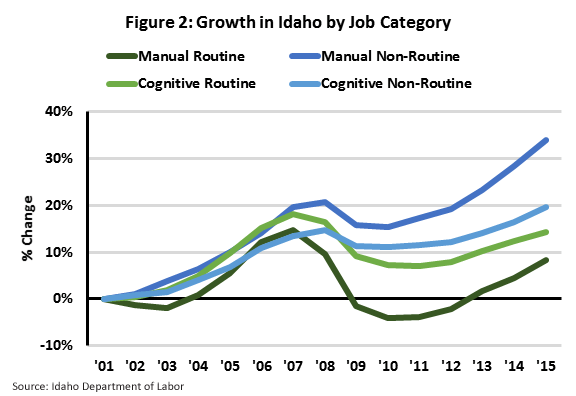
This framework can also help to explain why job growth has not been distributed equally across geographies. Industries vary significantly between geographic regions, and some regions may have an industry base that is more susceptible to automation than others. Indeed, it is clear that none of Idaho’s sub-state regions have been able to sustain strong job growth based on routine jobs. Non-routine jobs comprise the bulk of job growth in all six of Idaho’s regions, as seen in the following figure.


Sam.Wolkenhauer@labor.idaho.gov, regional economist
Idaho Department of Labor
(208) 457-8789 ext 4451