

The retail industry has been on a roller coaster ride over the past 25 years with a slightly negative trend line as shown in Figure 1. The housing bubble created tremendous demand for household furnishings and goods, which then plummeted with the Great Recession that caused shuttering of a handful of furniture stores and car lots in Twin Falls. Small retail businesses throughout south central Idaho suffered from the economic downturn ending in fewer local retail outlets available in rural areas.

Web-based retail has been a boon for those isolated areas that will never have a brick and mortar big box retailer to service its smaller population base. These rural populations can access products at volume savings thanks to the internet. Even better, if the purchase is sufficiently high, these goods are delivered at zero-cost and limited effort to the consumer. This is even more efficient than the Sears catalog that characterized Americana as early as 1894. Now, the diversity of products available to order has no limits, and drones are being developed to deliver them to our doorways.
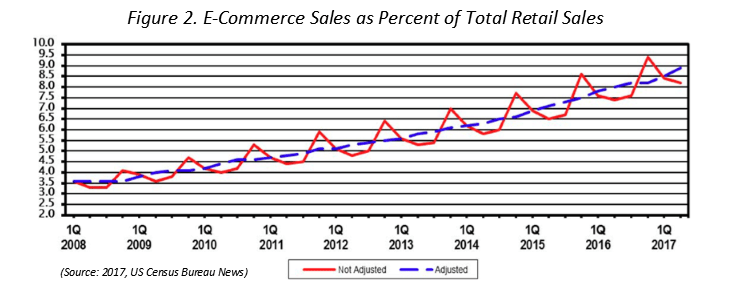
With recent reports of department store losses across the country and in Idaho, internet retailers have been the target of criticism and blame for these closures, but the data doesn’t support that theory. According to the U.S .Census Bureau, unadjusted e-commerce sales accounted for 8.2 percent of total retail sales nationally for the second quarter of 2017. The last seasonal peak was 9.5 percent for the third quarter of 2016, Figure 2. The majority of sales, about 90 percent, market their product to consumers that appreciate seeing, touching, hearing, tasting or smelling before finalizing the deal. Limits of internet infrastructure in pockets of the nation may also hold back e-commerce from absorbing a majority of retail sales.
One way to measure online retail is to use taxonomy or a combination of standard industry codes as a proxy for web-based or e-commerce to allow for job and establishment comparisons. The three industry codes include: 1) non-store retailers; 2) couriers and messengers; and 3) warehousing and storage. The proxy for physical or brick and mortar stores includes these three industry codes: 1) clothing and clothing accessories stores; 2) sporting goods, hobby, book and music stores; and 3) general merchandise stores. The physical stores have more establishments and higher employment than the web-based entities. However, the growth rate of web-based retail has surpassed the physical stores over the past 25 years.


Jan.Roeser@labor.idaho.gov, regional economist
Idaho Department of Labor
(208) 735-2500 ext 3639