


The following chart shows the number of Idahoans who turned 65 every year from 1980 to 2017 and then projected to 2030. Notice the steep growth starting around 2011, when the first baby boomers turned 65 years old. Adding to the challenge of replacing retirees is the relatively slower growth of Idahoans turning 25 years old, especially since 2005 and projected into the next couple of years.

North central Idaho and south central Idaho face the most difficulties dealing with the silver tsunami. About 24 percent of each region’s payroll workers are 55 years and older. Southwestern Idaho has the smallest percentage of older workers on its payrolls at 20 percent. All regions, however, have seen those percentages double since 1993.

Some industries face a much larger challenge replacing retirees than others. The following table shows the number of older workers 55 and over on industry payrolls and the percentage they made up of all payroll workers in 2017.
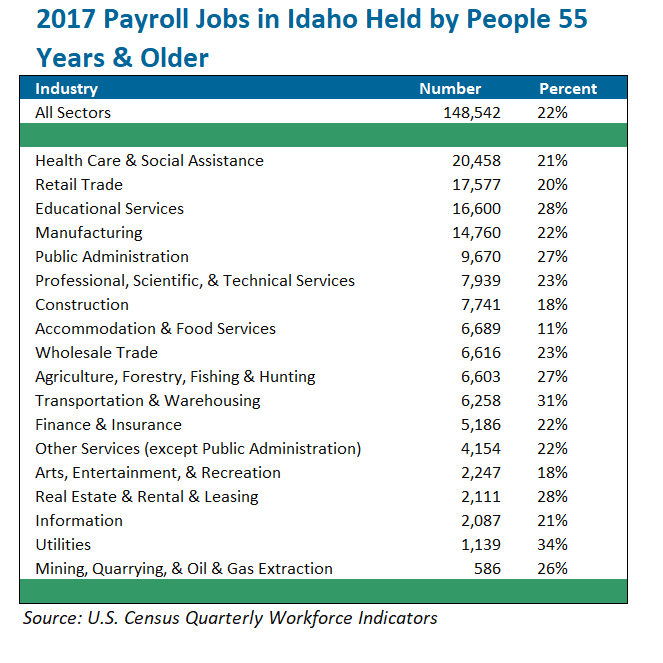
The industries with the largest percentage of older workers are utilities — electrical, gas, water, and waste (34 percent); transportation and warehousing (31 percent), which is experiencing extreme difficulties replacing aging truck drivers; real estate and rental and leasing companies (28 percent); education (28 percent); agriculture, forestry, fishing and hunting (27 percent); and public administration (27 percent).
The dramatic increase in older workers over the last 14 years is illustrated by the following table.
EMPLOYER RESPONSES TO THE SILVER TSUNAMI
Getting workers to postpone retirement: Many employers are encouraging senior workers to stay on with their company. That strategy is working, as labor force participation rates for Idahoans age 65 and older have increased. Employers are realizing the importance of keeping the most experienced and most productive workers, and are making concessions that make staying more likely. For example, some are offering part-time work, allowing older workers to enjoy more freedom, but also keeping them engaged in the workplace. Many older workers want flexible work schedules that allow workers to determine the time of the workday or longer periods (compressed work schedules). More businesses are also offering flexible schedules. As people grow older, they are more likely to suffer from disabilities. By offering them appropriate accommodation, businesses are more likely to retain older workers.
Transferring institutional knowledge: Businesses spend a lot of time and resources developing knowledge and capability. While some of it gets translated into procedures and policies, much of it resides in the heads of individual workers. In preparation for a mass exodus of experienced workers, some businesses are considering the best way to pass that institutional knowledge from retiring workers to new workers. Some are doing it through formal training programs; others are doing it through mentorships for the soon-to-be-retired workers of their potential replacements.
Kathryn.Tacke@labor.idaho.gov, regional economist
Idaho Department of Labor
(208) 799-5000 ext. 3984