
Tag Archives: Education

Hard Hats, Hammers and Hot Dogs Goes Social

Idaho Forest Group log processor

This Idaho Forest Group log processor grabs, strips and cuts logs as a student is shown the equipment controls.

A total of 400 students, more than 50 businesses and many volunteers participated in the 9th Annual Hard Hats, Hammers & Hot Dogs event in Kootenai County in early October. The career day is designed to give students exposure to manufacturing, construction, logging, truck driving, and a variety of other skilled trades.

Students toured the new North Idaho College Career and Technical Education (CTE) facility, located next to the Kootenai Technical Education Campus (KTEC) where the event was held. CTE has CAD technology, Welding, Automotive, Machine and CNC classes along with other technical programs.

After the tour, students were able to get hands-on experience operating dozers, skid steers, log processors and much more. The students also engaged in activities indoors with the idea of exposing them to the many occupational opportunities in North Idaho.
Continue reading

New Labor Regional Economist Discovers Diverse Character of Eastern Idaho

As a new resident of eastern Idaho, I am quickly learning there is much more to this traditionally rural area than I anticipated. Each region in Idaho is immensely different from one another, but eastern Idaho has vast diversity within itself. The rural, scenic, untouched beauty of Custer and Clark counties is hard for many people to find within a reasonable distance of their daily lives. In Idaho, these scenic views are just a couple of hours drive away. The Idaho Falls metropolitan area is alive, well and the forefront of economic mobility in the region. Although small compared to metro areas nationally, swift and advanced development of medical facilities, retail shopping and restaurants makes the Idaho Falls metro area an ideal place for young families or for a retirement in paradise. Along with the many economic upsides, there are also challenges for this part of the state.

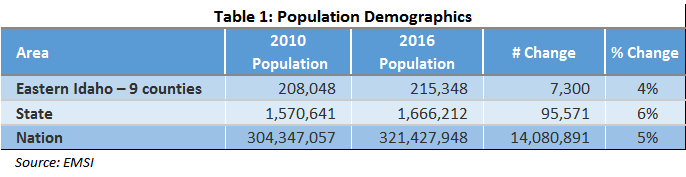
table-1

Eastern Idaho is made up of nine counties; one urban and eight rural. Each county has experienced population growth within the last few years. Teton County, a rural county and close neighbor of Wyoming, has experienced a 34 percent population hike since 2010. After recently visiting the towns of Victor and Driggs, the reasons behind this rapid growth are clear. These quaint towns are infused with rich culture, diverse food and gorgeous views of the Teton Mountains with the kind of outdoor recreational activities most people dream about. For these reasons and more, there is an influx of migrants – retirees, young outdoor enthusiasts and people of all ages – swarming to these towns looking for adventure.

Continue reading

North Idaho College to Use $25,000 Micro-Grant for Aviation Industry Training

North Idaho College plans to use a $25,000 Idaho Department of Labor micro-grant to train 28 aviation assemblers and mechanic assistants beginning this summer.

Initially, training will be offered to high school seniors who want to work in the industry after graduation. The first of two courses will take place this July and the second in July 2017 at Sandpoint High School. Training will include a combination of online courses and classroom laboratory settings. Those who complete the assembler course in the summer following graduation will be eligible for employment.

Read more details in the full news release.

Educated People Moving to Idaho, Growth Concentrated in Cities

Migration into Idaho is, in some ways, a study of contrasts. While Idaho ranks 16th in the nation for state-to-state migration of people over 25 years old, 99 percent of that migration is into the Boise metro area. In 2014, 3,104 adults moved from another state into Idaho of which 3,066 moved to one of the six counties that encompass Idaho’s Treasure Valley. The only other places in Idaho that saw a positive flow from outside of the state were Coeur d’Alene (Kootenai County) and the Magic Valley, though still low. Because the Lewiston metro area straddles the state line, it was excluded from this analysis which examined only state-to-state and metro-to-state flows.1-Net-I_state-Migration

Source: U.S. Census Bureau, American Community Survey

2-Idaho-Interstate-Gain_LossSource: U.S. Census Bureau, American Community Survey

Most adults moving into Idaho had a high school diploma but no college experience nor a post-secondary degree. In fact, for every one adult with a bachelor’s degree or higher who moved in, five adults with no more than a high school diploma moved into Idaho at the same time. This ratio improves with adults who had some college experience or an associate’s degree; for each one of these adults who moved into the state, two with no more than a high school diploma also moved in.

Continue reading

Job Market Looks Good for Spring College Graduates

The class of 2016 is likely to enjoy the best job market for new college graduates in 10 years — both nationally and in Idaho.

U.S. employers say they plan to hire 11 percent more college graduates this spring than last, according to a late October survey by the National Association of Colleges and Employers. About 42 percent of survey respondents characterized the job market for class of 2016 as “very good” or “excellent.” Two years ago, only 18 percent did. A Michigan State University survey of employers around the same time projected a 15 percent increase in hiring for college graduates.

Continue reading

Considering a College? Rate Them on Your Own Terms.

If you search the Internet for  “college rankings” you’ll get hundreds of results, including rankings of best colleges from well-known sources such as US News & World Report, Princeton Review and the Washington Post. Rankings from lesser-known sources such as Mother Jones, SB Nation and various blogs and Facebook pages also exist, along with worst-colleges lists, rankings of online schools and lists of schools rated solely on athletic performance, weather, parking and concert venues. It seems like everybody else knows best where YOU should take this important next step in your life!

Take control of the decision by knowing the specifics about schools that also take your personal requirements into consideration.

Continue reading

Idaho Gender Wage Gap Narrows Slightly

In 2013 working women in Idaho made major wage gains. Combined with wage erosion suffered by working men significantly, those gains closed the gap in their wages with men.

Moving to 87.6 percent of the median wage paid to men, Idaho women were closer to matching men’s paychecks in all but three other states.

However, the inequity still exists. Are there favorable trends that indicate change? Is this true globally? What can be done to end the inequity? Continue reading

Deciding on a College? A Campus Visit May Help

Are you among the thousands of students who will visit colleges this summer?

Visiting a new place and imaging living there for four years can be daunting. Chances are you, like many of your fellow students, have never been as completely on your own as you will be the fall after your high school graduation, so it is important to check out some of the places you are considering. One great way is a visit to the school to find out if it’s a good fit for you.

How to get started

The best time to visit a prospective college or university is during a middle-of-the-term week, so you can observe typical day-to-day campus life. Figure out when you and a parent or other interested adult can get away from school and work, then contact the school to make appointments with a financial aid counselor and the admissions office. Most schools have information on their website for prospective students that includes how to set up appointments and tours.

And don’t forget your own special interests—you may want to visit when you can watch the spring theatre production rehearsal or a lacrosse team practice. Don’t plan to visit during homecoming week or during exams (many students and staff will be too busy to spend time with you). Remember that people you want to visit with might be unavailable during winter or spring break.

Continue reading

Education Levels Rising in Idaho

The education level of Idaho’s workforce rose steadily after World War II as more youth completed higher levels of education than previous generations and replaced retiring workers with less education.

Educational levels have grown more slowly in the past couple decades, and today’s retirees have roughly the same educational level as the young adult population of the generation preceding them. Continue reading

Number of College-Age Unemployed Leaving Idaho Declines

The number of out-of-work, college-educated Idahoans leaving the state appears to be declining, but more are moving elsewhere than unemployed college-educated workers coming to Idaho from other states, based on interstate unemployment insurance claims.

Over 200 Idaho workers with college degrees or higher were receiving unemployment payments in other states at the end of 2012 and the beginning of 2013 while about 50 workers with degrees from other states were collecting benefits in Idaho.

Continue reading