Tag Archives: Age

Recruiting, retaining baby boomers brings value to nonprofit organizations

Baby boomers are typically hard-working individuals, resourceful, experienced and they value relationships, according to research from Indeed.com. These and other characteristics make them ideal for volunteer opportunities.

This age group, generally classified as ages 59-77, are often retired and looking to volunteer at organizations where they can make an impact and use their skills. To broaden an organization’s scope of skills consider recruiting older volunteers (55 and older) who are experienced, highly responsible and will commit long-term to an organization. In order to attract this demographic, there are some key factors the organization can focus on to recruit and retain these volunteers.

Recruitment

When recruiting baby boomers emphasize the organizations’ values and impact on the community. To do so, consider the best way to reach volunteers who are 55 and older.

For non-profits in an area with limited internet access consider advertising. Look to the local newspaper or a free ads paper, like the Penny Saver. To get the word out, consider hosting a get-to-know the organization session or ask to share information volunteer opportunities with the local senior center or church.

Continue reading

Seniors Benefit from AmeriCorps Senior Companion Programs in Idaho

Research has shown volunteers 55 and older who serve as senior companions often find they also reap significant financial and health benefits from the experience.

Photo; Elderly woman and older man talking on park bench.Idaho’s AmeriCorps Seniors Companion volunteers visit homes, help the person leave the house to go shopping, to doctor appointments and even the senior center for bingo. Volunteers also help with bills, laundry and engage in conversation over a cup of coffee.

According to a study on AmeriCorps senior programs,* benefits for individuals getting assistance include:

  • Spending time with others.
  • Living in their home.
  • Cost of living stays down. The median monthly cost of an assisted living facility is $4,051 compared to the mean monthly housing expenditure of $1,505. Annual cost savings reach $30,552 per person.
  • Improved health and decreased hospital visits. The federal government saved nearly $59 million each year on Medicare and Medicaid health care expenditures.

Continue reading

COVID-19 Impacts Idaho’s Older Workers

The 416,000 Idahoans who are in their 50s and 60s face many challenges because of the coronavirus economic impact.

Loss of business income. The COVID-19 pandemic has greatly reduced revenues of many Idaho businesses. It also is likely to lead to the permanent closure of some businesses, especially restaurants, entertainment operations, lodging and retail stores. Since older adults are more likely to run their own businesses, they are disproportionately impacted. According to the Bureau of Labor Statistics, about 24 percent of American workers 65 years and older are self-employed, while 15 percent of workers 55 to 64 years are self-employed. In comparison, 8 percent of workers under 55 are self-employed.

Joblessness. About 16 percent of Idaho’s 162,000 payroll workers 55 years and over filed new unemployment insurance claims between March 15 and June 13. Some returned to work within a month, but others experienced two or three months of joblessness.

Continue reading

Silver Tsunami Could Swamp Idaho Employers

The silver tsunami — the aging of the baby boom generation — is posing a challenge to Idaho employers throughout the state. In Idaho, baby boomers – Americans born between 1946 and 1964 – are retiring at the rate of 52 a day. In a tight labor market, replacing these workers is not easy. Even when a replacement worker is found, the business has still lost an experiencedworker with deep institutional knowledge about the business — things like how a problem that just cropped up was solved 15 years ago, who’s the best contact at a supplier that isn’t providing what was promised, and other insights that contribute to a business’s competitiveness and bottom line.

Continue reading

More Idahoans Postponing Retirement

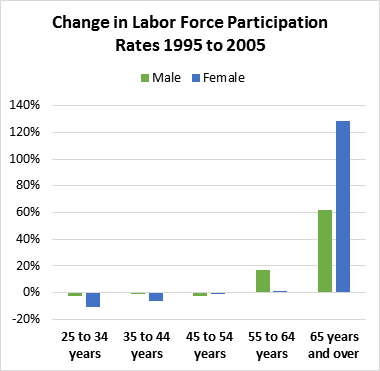
For more than two decades, older Americans have opted to stay in the labor force longer, while younger Americans have reduced their labor force participation. Women are likely to continue working in their 60s. Since the start of the recession in December 2007, the share of older working women has grown while the percentage of every other category of U.S. worker – by gender and age – has declined or remained flat. In 1992, one in 12 American women worked past age 65. Now, around one in seven do. The U.S. Department of Labor projects that number grow to almost one in five by 2024.

Idaho also has seen large increases in labor force participation for senior workers — 62 percent for men and 129 percent for women — while other workers’ participation declined or remained flat.

Chart-1Source: U.S. Census Bureau

In 1992, one in 18 Idaho women worked past age 65. Now, around one in seven do — the same ratio as the nation.

With baby boomers in their 50s and 60s swelling the ranks of older workers and their labor force participation on the rise, Idaho workers 55 and over grew by 161 percent, from 64,300 in December 1995 to 167,500 in December 2015, according to the Current Population Survey, the monthly survey conducted by the Census Bureau to track unemployment in the U.S. Over the same period, Idaho’s labor force 25 to 54 years of age doubled from 145,200 to 296,100.

Continue reading

Aging Workforce and Health Care Employment

There’s a common perception in economic discussions that an aging population – often defined as a growing population of retirees – drives health care employment, which sounds logical. In a general sense, the health care services and age have a “u-shaped” relationship – people need the health care industry the most at the beginning and the end of their lives.

Median-age-and-healthcare

Source: Idaho Department of Labor

This topic is especially important for Idaho as it has become a popular destination for retirees and is one of the nation’s fastest aging states. Low cost of living, bountiful recreational activities and a tax system favorable to retirees have often been cited as the reasons for this. Whatever it is that brings retirees to Idaho though, it is certain that they are indeed moving to Idaho in large numbers. Idaho has ranked in the top 10 among all states for the fastest growing retirement populations for several years.

Continue reading

Millennials Bring Different Expectations to Work

Millennials began to enter the workforce in 2006, just a year before the last recession began to bite into the economy. Nine years later, during the first quarter of this year, millennials have surpassed the baby boomers – people born approximately between 1946 and 1964 – as the largest generation in the workforce.

Millennials – individuals born approximately between 1982 and 2004 – bring with them a different outlook and view of the workplace than previous generations. Due to their size, and the uniqueness they bring, it helps for employers to understand some key differences in this group. In general, they 1.) place a greater emphasis on work-life balance; 2.)  focus on the community in which they live to the degree that it takes precedence over job considerations and 3.) desire to work for companies motivated by more than just baseline profit.

Continue reading

Ages and Wages Affect Idaho’s Future Workforce Capacity

This is the first of a two-part article, providing an overall view of worker ages across the state by industry sector.

The aging of Idaho’s workforce indicates future labor shortages in manufacturing, transportation and warehousing, utilities and government sectors.

Possibly most noticeable is the potential future of a worker shortage in educational services , which is key to providing essential education and training to propel individuals into higher-skilled, better paying jobs.

Continue reading

Future Workforce to Rely on Millennials

Millennials – people born between 1980 and the late-1990s – are the largest generation in the U.S. population and critical to economic success of the nation and Idaho. Today, there are almost 73 million millennials in the U.S. and over 365,000 in Idaho, where they are growing faster than the rest of the nation. This particular demographic also represents the workforce of the future.

Employers often characterize millennials as lacking soft skills, entitled, unmotivated and having a tendency to “job-hop.” While there is undoubtedly a need for this cohort to meet an employer’s expectation for soft skills, it is also worth taking a deeper look at the root cause of these stereotypes and identify any underlying circumstances that might influence the ability of millennials to succeed in today’s job market.

Idaho millennials are more likely to have a job, but on average, earn about $3,000 less than their national counterparts and are more likely to live in poverty. While education rates have increased in Idaho and nationally since 1980, Idaho millennials are also significantly less likely to hold a bachelor’s degree or higher, which could explain the below-average wages they earn compared to their counterparts.

Nationally millennials are living at home with a parent and the rate of those living alone has remained stable and low. Compared to the US, Idaho millennials are less likely to live alone or with a parent and much more likely to be married. They are also slightly more likely to be veterans and significantly less likely to be minorities.

Continue reading

Idaho Wages Leanest for Young Workers

Wages grow with age, but there is a point of diminishing return where retirement may be a better alternative to continuing to work with scant hope for increasingly higher pay. In Idaho for example, cost of living adjustments yielded greater increases for retirees than state workers experienced on their paychecks during the Great Recession.

This depends on the industry, however. There are a number with older leadership and workforce such as utilities, education and agriculture. The mid-life years of 45 to 54 are the peak wage-earning time.

Average Monthly Wage

Continue reading