Tag Archives: Age

Idaho’s Over-55 Population on the Rise

Idaho’s population remains one of the youngest states in the nation, but continues to age faster than most others, new U.S. Census Bureau estimates show. Even the nation’s youngest county, Madison in eastern Idaho, aged slightly faster than eight other Idaho counties.

The median age statewide was 35.5 years in 2013, more than two years younger than the national median age. Just four states – North Dakota, Texas, Alaska and Utah – and the District of Columbia were younger.

However, since 2010, Idaho’s median age has increased nearly a full year – from 34.6 years. Only Maine, New Hampshire and Utah saw larger increases.

Continue reading

Some Idaho Industries More Apt to Hire Older Workers

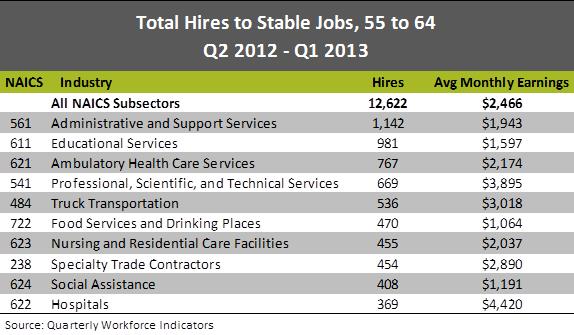
The aging workforce will have an overarching effect on the economy in the years to come, but older workers are feeling the impact now. With the effects of the last recession still lingering, knowing which industries are more apt to hire older workers is critical to today’s job seekers.

table 1

Continue reading

Retirements Open Job Opportunities in Idaho’s Wood Products Industry

A guiding principle of the wood and paper products industry is to reforest after harvesting – planting new trees for future generations. Now, as baby boomers retire, northern Idaho wood products manufacturers are applying that same principle to their workforce.

There are 240 wood products and paper manufacturing businesses employing 6,800 people in 40 of Idaho’s 44 counties. Using the statewide multiplier of 2.79 for all wood products and paper manufacturing subsectors, combined they create another 12,136 jobs in other sectors across the state. To further signify the industries’ role in Idaho’s overall economy, the annual average wage is $42,620 – 18 percent higher than the average wage for all industries.

Over half of Idaho’s wood and paper products jobs are in the 10 northern counties, and most of the rest – 36 percent – are in southwestern Idaho. Nearly one in three manufacturing jobs in Idaho’s 10 northern counties is in wood and paper products, making these regions highly dependent on the industry and its rolling multiplier effect.

Wood products table 1

Nonetheless, the industry has identified a void in its aging workforce.

Nearly half the workers are 45 or older, leaving mill managers mulling future workforce needs. One in four northern Idaho mill workers is set to retire in the next 10 years – 23.5 percent are 55 and older compared to 20.5 percent statewide. Another 31 percent are between ages 45 and 54 in the north compared to 26 percent statewide.

Wood products table 2

Log scalers and saw filers were becoming obsolete, and increased mechanization in the mills generated a need for industrial control technicians – electricians trained on program logic controllers, or PLCs. With that, a partnership was formed between North Idaho College, the Idaho Department of Labor and the three largest wood product manufacturers in northern Idaho – Idaho Forest Group, Potlatch and Stimson.

To meet industry needs – especially as the knowledge, skills and expertise of the baby boomers disappears with their retirements – the state’s Workforce Development Council approved a new Industry Sector Grant program. It uses Workforce Development Training Funds to assist Idaho employers in creating new jobs or retaining existing ones. The fund is financed with a 3 percent offset of employer unemployment insurance taxes. It reimburses employers for training costs for jobs that pay at least $12 per hour and include employer-assisted medical benefits.

As a result of collaborative efforts and the state’s Industry Sector Grant program, a Wood Products Manufacturing Center of Excellence was created at the college to focus on training logic controller technicians, or PLC electricians, saw filers and log scalers as part of the industry’s succession plan.

Wood products table 3

The wood products consortium received $374,000 to run training programs for these occupations over the next two years – $281,000 from the training fund and the rest in a match from the businesses. The center at the college’s Workforce Training Center has been operating since Jan. 1.

Other regions across the state could benefit from this pilot program as well. With 36 percent of the wood products and paper industry in southwestern Idaho, similar partnerships could apply a similar foundation to fill their employer needs.

The number of job openings in wood products and paper manufacturing is at 2007 levels. There were 712 job openings statewide in 2012 – 14 percent more than in 2007. In 2013, job openings slowed but still remained around 2007 levels with 600 jobs posted through the Idaho Department of Labor. Electricians, kiln operators, truck mechanics and skilled saw filers were among some of the good-paying jobs the industry needed to fill.

The output of Idaho’s wood products sector is likely to grow considerably in the next 10 years, and the need to replace an aging workforce is a growing concern. As the housing market continues to recover and housing starts normalize, mills across the state have leapt back into full production. Growing population and increased prosperities in China and other Asian countries increased those countries’ imports of Idaho wood products, which should continue. Declining competition from imported western Canadian wood products due to the risk of disease and pests is also expected to reduce timber harvests in British Columbia and Alberta. The U.S. Forest Service is willing to increase timber harvests on public lands, and the Clearwater Basin Collaborative and the Panhandle Forest Collaborative are expected to lead to more federal timber sales.

A bright future looms in the wood products industry. The center will train the next generation of workers in an industry that has always been the backbone of northern Idaho’s economy.

Alivia.Metts@labor.idaho.gov, regional economist
(208) 457-8789 ext. 348


Will Baby Boomers’ Retirement Affect Idaho’s Economy?

births per 1000b

Baby boomers have been shaking the economy ever since their birth. Now, they are starting to reach traditional retirement age. How quickly they retire and how high their incomes are after retirement will have a significant effect on Idaho’s economy.

What was the baby boom?

Since their birth in the 18 years after World War II ended, this enormous generation has affected the economy. In their childhood, they dramatically increased the demand for baby paraphernalia, children’s clothing and toys. As they entered their teens and began working, they swelled the ranks of workers, spurring U.S. productive capacity. Now, they are in their 50s and 60s, and they may be rewriting what it means to be a senior citizen.

They were born during the “baby boom” that followed World War II. Americans had dramatically reduced births rates during the Depression that began in 1929 and lasted until America entered the war in 1941. During the war, millions of Americans put off marriage and children. Once, the war ended in August 1945, marriage and babies were high on the agendas of millions.

Continue reading

Job Seekers: Overcoming the Myths of Older Workers

Being told they are overqualified or they won’t stick around long are just a few of the perceptions  job seekers over the age of 50 find themselves having to overcome during their search.

Bud Swanson, a workforce consultant for the Idaho Department of Labor’s Boise office, shared his ideas to help mature workers learn how to focus on their strengths and what they have to offer an employer.

Idaho Department of Labor workforce consultant Bud Swanson can help older job seekers focus on their strengths in their job search.

Idaho Department of Labor workforce consultant Bud Swanson can help older job seekers focus on their strengths in their job search.

What are some of the myths about older adult workers and how can a job seeker combat them?

Continue reading

Labor Force Structure Experiencing ‘Silver Tsunami’

workers 45plus

Idaho may not be home to hurricanes, but it has certainly experienced a “silver tsunami” – the rapid shift toward an older workforce.

While the state population grew 20 percent between the 2000 and 2010, employment levels for workers age 45 and older grew 34 percent.

Idaho’s labor force has experienced a significant structural change over an extended period – a demographic shift adding nearly 140,000 workers age 45 and older between 1991 and 2012. The population of workers age 25 to 44 increased by only 50,470.

Worker migration data is also uncovering the tsunami’s existence. Interstate unemployment claims in January 2013 revealed nearly 800 claims were made by workers age 65 and older – more claims than all other age groups combined. These interstate claims reflect the number of claims made by individuals who now reside in Idaho but are claiming unemployment benefits for jobs lost in other states.

Continue reading

FAQ Friday – What do I do when I can’t get an interview?

Sometimes the answer may be simply that there are many applicants to choose from. Remember there are a lot of employers out there and maybe getting an entry level job elsewhere could help you get a job with their perfect employer at a higher level in the future. In the meantime…Computrol

Get a Second Opinion on how you present yourself to prospective employers in a résumé, cover letter or in person. Ask an Idaho Department of Labor consultant to review these items and how you can better portray yourself to the employer.

Can YOU Read Your Writing? Was your application legible? Some company hiring managers won’t even consider you if they can’t read your writing. Did you fail to complete your application, explain your strong skills, abilities, and training or education? Did you go to the office on Monday, the busiest day of the week, or at closing time? Try a mock “turn in your application” the exact way you did with the last company you visited, and do it with someone who will give you some feedback. You may discover some issues you haven’t thought of before. Make sure everything is filled in on the application, and if the subject doesn’t pertain, a simple (n/a) is adequate, but don’t leave it blank.

Continue reading

Recession Affected Age Groups Differently

by Alivia Metts, Regional Labor Economist, Northern Idaho

Idaho’s youngest workers – those age 14 to 18 years old – bore the brunt of the downturn while Idaho’s older workers appeared to hold their own according to statistics from the U.S. Census Bureau.

Turnover among teen workers remained high through the recession although the rate of turnover eased as young workers held on to their jobs as employment openings dwindled.

Workers age 55 and older started retiring at a faster pace through the recession. From 2007 to 2010, more firms lost workers in that age group than in any other.

By every indicator, Idaho’s oldest and youngest workers were more affected by the recession than any other age group. Teenagers in Idaho lost 35 percent of their jobs while the oldest workers managed to find more employment opportunities even as hiring overall slowed dramatically. Continue reading